PuzzleFree
Jigsaw Puzzles for Adults: Calm, Focus & Flow
January 11, 2026
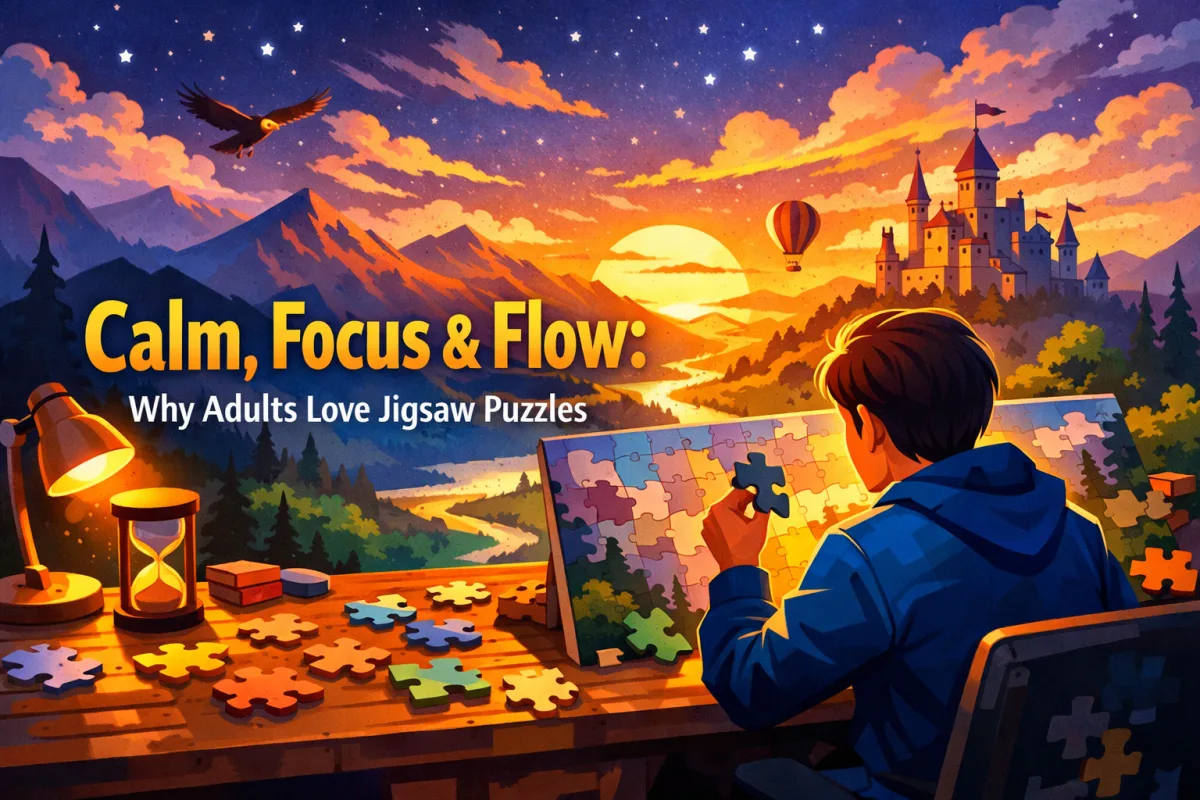
Jigsaw puzzling is more than a “nice hobby.” It’s a repeatable mental practice that combines attention control, visual reasoning, and gentle problem-solving in one physical task. When adults say puzzles help them feel calmer and more focused, they’re often describing a specific psychological state: flow—deep concentration with a steady sense of progress.
In this article, we’ll treat “jigsaw puzzling” as a clear concept (an entity): a structured activity with inputs (pieces, image, time), processes (search, match, verify), and outputs (completed sections, satisfaction, calm). Then we’ll break down why it works so well for adult brains and busy lives.
What a Jigsaw Puzzle Really Is (as an Entity)
A jigsaw puzzle is a closed system with clear rules and an attainable goal. That matters. Your brain can relax because the problem is bounded: all the pieces you need are already on the table, and the finished picture is definable.
| Component | What You Do | What Your Brain Gets |
|---|---|---|
| Visual target (the image) | Recognize colors, shapes, patterns | Low-stress sensory engagement |
| Piece geometry | Test edges, tabs, and blanks | Fast feedback and certainty |
| Search space | Sort, scan, narrow options | Focus through constraints |
| Progress markers | Finish corners, borders, sections | Motivation via visible wins |
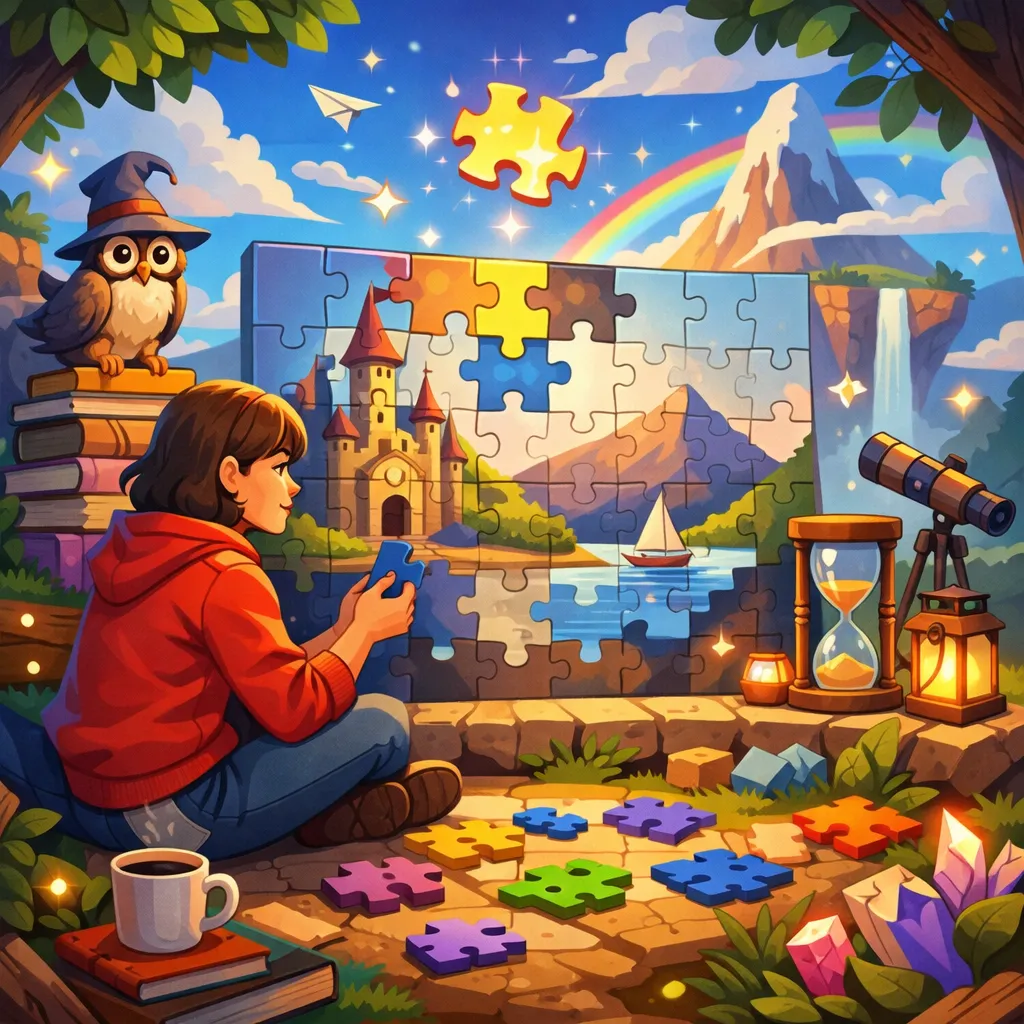
Calm: Why Puzzling Feels Like a Mental Reset
Adults carry “open loops” all day: unfinished tasks, messages, decisions, and background worries. Puzzles reduce that noise by replacing scattered attention with a single clear task. The activity is quiet, tactile, and predictable—three qualities that often signal safety to the nervous system.
Why a Bound, Solvable Task Lowers Stress
Many modern problems are ambiguous and never fully “done.” A puzzle is different: it offers a final state. That clean finish can feel restorative, especially after work that is abstract, digital, or socially demanding.
“A good puzzle gives your mind something firm to hold onto—complex enough to be interesting, simple enough to be finishable.”
Micro-rewards Without the Doomscroll
Each correct placement is a small confirmation. Unlike endless feeds, a puzzle’s feedback is meaningful: correct or not, move forward or try again. This creates satisfaction without the jittery feeling of random rewards.
Focus: How Puzzles Train Attention Gently
Jigsaw solving is attention training disguised as play. You repeatedly practice selecting one thing (a piece) from many options, keeping a target in mind (where it might fit), and verifying the result. Over time, this reinforces mental skills that are useful outside the table: patience, sustained concentration, and ignoring distractions.
The “Single-Thread” Effect
When you puzzle, you usually do one cognitive thread at a time: edge search, color grouping, or pattern matching. That reduces task switching, which is often what makes adults feel mentally drained.
Practical Focus Techniques Adults Naturally Use
- Edge-first setup: simplifies the problem space and builds structure.
- Color and texture sorting: reduces visual overload.
- Section-by-section strategy: creates short, finishable milestones.
- Lighting and surface control: lowers friction and keeps attention stable.
Flow: The Real Reason Many Adults Get Hooked
Flow happens when challenge matches skill and the next step is clear. Jigsaw puzzles hit this sweet spot because you can adjust difficulty (piece count, image complexity, cut style) and still keep a visible path forward.
How Jigsaw Design Supports Flow
| Design Choice | What It Changes | Flow Impact |
|---|---|---|
| Piece count (300 / 500 / 1000+) | Time and search space | Controls challenge and pacing |
| Image style (high contrast vs. subtle) | Visual clues available | Too subtle may break momentum |
| Cut type (random vs. grid) | Predictability of shapes | Random cuts increase problem-solving |
| Section landmarks (skyline, text, objects) | Anchors for progress | More anchors = smoother flow |
Flow Is Also About “Good Friction”
Puzzles are not instant. They provide just enough resistance to feel earned. That’s why finishing a section can feel deeply satisfying: you didn’t just consume content—you built order from chaos, one piece at a time.
Why Adults Prefer Puzzles Over Some Other “Relaxing” Activities
Many relaxation habits are passive: scrolling, binge-watching, or background entertainment. Puzzling is active but not overwhelming. It’s a middle gear—engaging enough to quiet the mind, calm enough to recover.
Quick Comparison: Puzzles vs. Common Wind-Down Options
| Activity | Effort Level | Attention Quality | Typical After-Feeling |
|---|---|---|---|
| Jigsaw puzzles | Medium | Steady, intentional | Calm, satisfied |
| Social media | Low | Fragmented, reactive | Restless, overstimulated |
| TV series | Low | Passive | Relaxed or numb |
| Strategy games | High | Intense, competitive | Wired, energized |
Practical Ways to Make Puzzling More Calming and Focused
If you want puzzles to reliably produce calm and flow, treat the setup as part of the craft. Small changes in environment reduce friction and keep your brain in the “pleasant challenge” zone.
Step-by-step Setup (Adult-Friendly)
- Pick the right difficulty: choose an image with clear landmarks if you’re tired.
- Start with structure: build corners and borders to create a frame.
- Sort with intention: separate by color, texture, and obvious objects.
- Work in short loops: 20–40 minutes is often enough to reach flow without fatigue.
- End on a “next step”: leave a small cluster ready, so returning feels easy.
Digital Puzzles and Modern Platforms
Online jigsaws keep the same core entity—piece selection, visual matching, progress feedback—while changing the interface. Digital puzzles can add convenience (no missing pieces) and adjustable difficulty, but they still rely on the same mental mechanics that support calm, focus, and flow.
For example, a platform like PuzzleFree.Game can offer different images and difficulty levels, but the reason adults enjoy solving remains consistent: the task is bounded, feedback is clear, and progress is visible.
Key Takeaways
- Jigsaw puzzling is a structured, solvable system that reduces mental noise.
- It supports calm through predictability and tactile, focused attention.
- It builds focus by training single-thread thinking and reducing task switching.
- Flow emerges when difficulty matches skill and progress stays visible.
- Simple setup choices can make the experience noticeably more restorative.