PuzzleFree
Jigsaw Puzzles in Movies: Films & Puzzle Metaphors
February 2, 2026
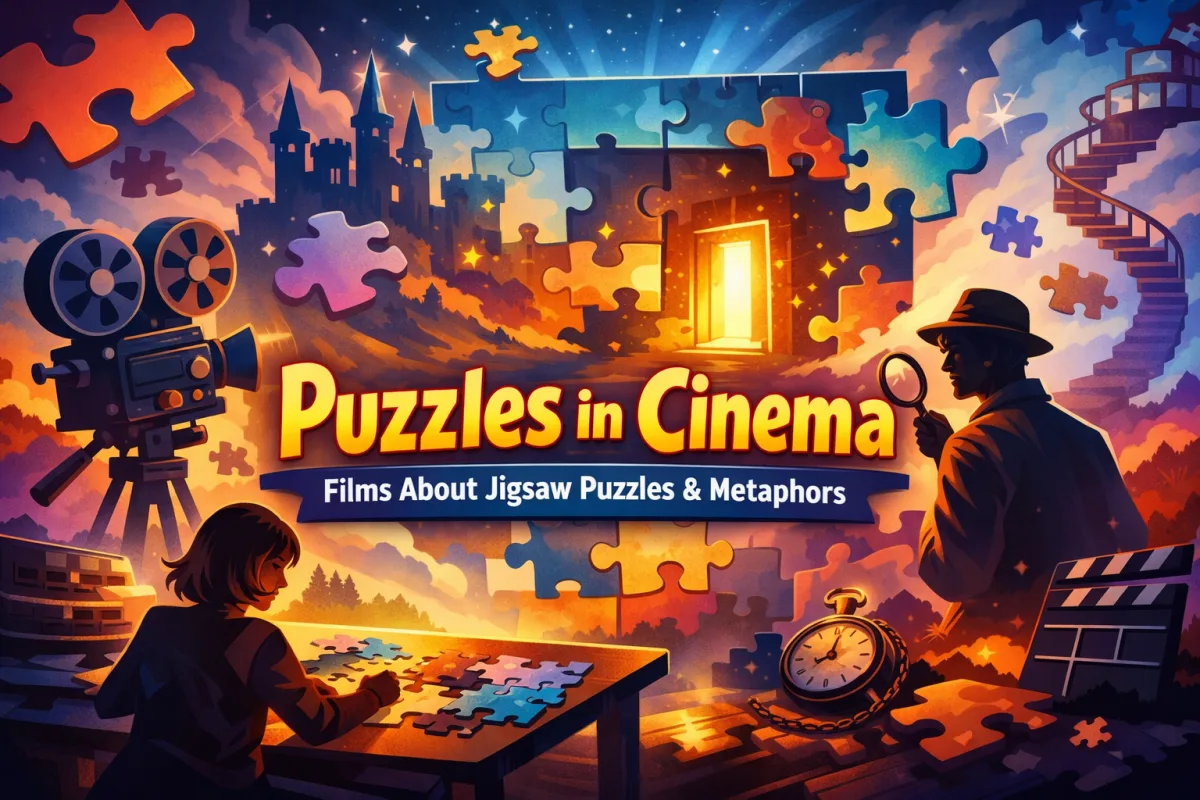
Jigsaw puzzles appear in cinema far less often than one might expect. Despite being visual, symbolic, and psychologically rich, puzzles are rarely shown as a real activity on screen. Instead, filmmakers usually transform puzzles into metaphors: for memory, identity, morality, or fragmented reality.
This article is structured to match clear search intent. First, we explore films where jigsaw puzzles exist literally and play a meaningful role. Then we move to movies where puzzles function as a narrative or psychological metaphor. This separation helps answer two common questions users search for: “Are there films about jigsaw puzzles?” and “Why are so many movies structured like puzzles?”
Films Where Jigsaw Puzzles Are a Real Part of the Story
Puzzle (2018)
Puzzle (2018) is the most complete and well-known film where jigsaw puzzles are central to the plot. The story follows Agnes, a woman living a constrained suburban life, who unexpectedly discovers an exceptional talent for assembling puzzles.
Jigsaw puzzles are not decorative here. The camera repeatedly focuses on puzzle pieces, edges, colors, and the physical act of assembly. Puzzle competitions, time limits, and concentration become narrative drivers. For viewers searching for a movie truly about puzzles, this is the primary answer.
Puzzle / Rompecabezas (2010, Argentina)
The 2018 film is based on the Argentine original Puzzle (2010), also known as Rompecabezas. This version is quieter and more introspective, with even greater attention to the process of puzzle-solving itself.
The film emphasizes patience, repetition, and solitude. It reflects how jigsaw puzzles function in real life: not as spectacle, but as a private mental space where order slowly emerges from chaos.
Citizen Kane (1941) – Famous Puzzle Scene
Although Citizen Kane is not a film about puzzles, it contains one of the most iconic jigsaw puzzle scenes in cinema history. Susan Alexander Kane is shown endlessly assembling puzzles inside a massive, empty mansion.
The puzzle is literal, but its meaning is symbolic: isolation, emotional emptiness, and time passing without purpose. This scene strongly influenced how puzzles are later portrayed in film — as quiet, solitary, and introspective activities.
The Thomas Crown Affair (1999)
A short but memorable scene shows a character assembling a complex jigsaw puzzle. The act signals intelligence, control, and discipline. While puzzles are not central to the plot, their presence reinforces the association between puzzle-solving and focused mental power.
Conclusion of Literal Puzzle Films
From an SEO and factual perspective, there are only two films where jigsaw puzzles form the core of the narrative. All other appearances are brief or symbolic. This scarcity explains why many users struggle to find movies that are genuinely about puzzles.
Puzzles as a Metaphor in Cinema
Much more often, films are structured like puzzles. Information is fragmented, chronology is broken, and the viewer must actively assemble meaning. In these cases, the audience becomes the puzzle solver.
Memento (2000)
Memento is constructed as a broken jigsaw puzzle. Scenes are shown in reverse order, memory is unreliable, and understanding the story requires active reconstruction. The viewing experience closely resembles assembling a puzzle without a reference image.
Shutter Island (2010)
This film presents a puzzle of identity and perception. Clues are rearranged throughout the story, forcing the viewer to question what is real. The final reveal feels like the last missing puzzle piece — or the realization that the image itself is flawed.
Inception (2010)
In Inception, layered dream levels function like nested puzzles. Each layer depends on the stability of the others. Understanding the full picture requires holding multiple partial structures in the mind simultaneously.
A Beautiful Mind (2001)
The puzzle here is perception. Patterns, codes, and imagined connections dominate the narrative. The audience must later reassemble the story, separating real pieces from false ones.
Cube (1997)
Cube presents a literal spatial puzzle. Each room is a piece of a larger structure, and survival depends on collective reasoning. The film visualizes puzzle logic as physical space.
Saw (2004)
Despite its name, the Saw franchise uses puzzles mainly as moral and psychological tests. The idea of life being broken into pieces that must be assembled through suffering is central to its identity.
Why Movies Rarely Focus on Real Jigsaw Puzzles
Jigsaw puzzles are quiet, slow, and internal. They rely on repetition, concentration, and patience. Commercial cinema typically prioritizes movement, conflict, and dialogue, making puzzle-solving difficult to translate into dynamic scenes.
As a result, puzzles are usually reduced to symbols rather than shown as meaningful practices. When they do appear, they instantly communicate introspection and psychological depth.
Why This Matters for Modern Puzzle Culture
The lack of films about real jigsaw puzzles highlights an untapped cultural space. While cinema rarely explores puzzle-solving directly, millions of people engage with puzzles daily through physical sets and online platforms.
Puzzles remain powerful because they mirror how humans search for order and meaning. Whether shown as scattered wooden pieces or as fragmented narratives, puzzles continue to represent the structure of human thought.