PuzzleFree
Calming Screen Time: Digital Jigsaw Puzzles for Adults
January 12, 2026
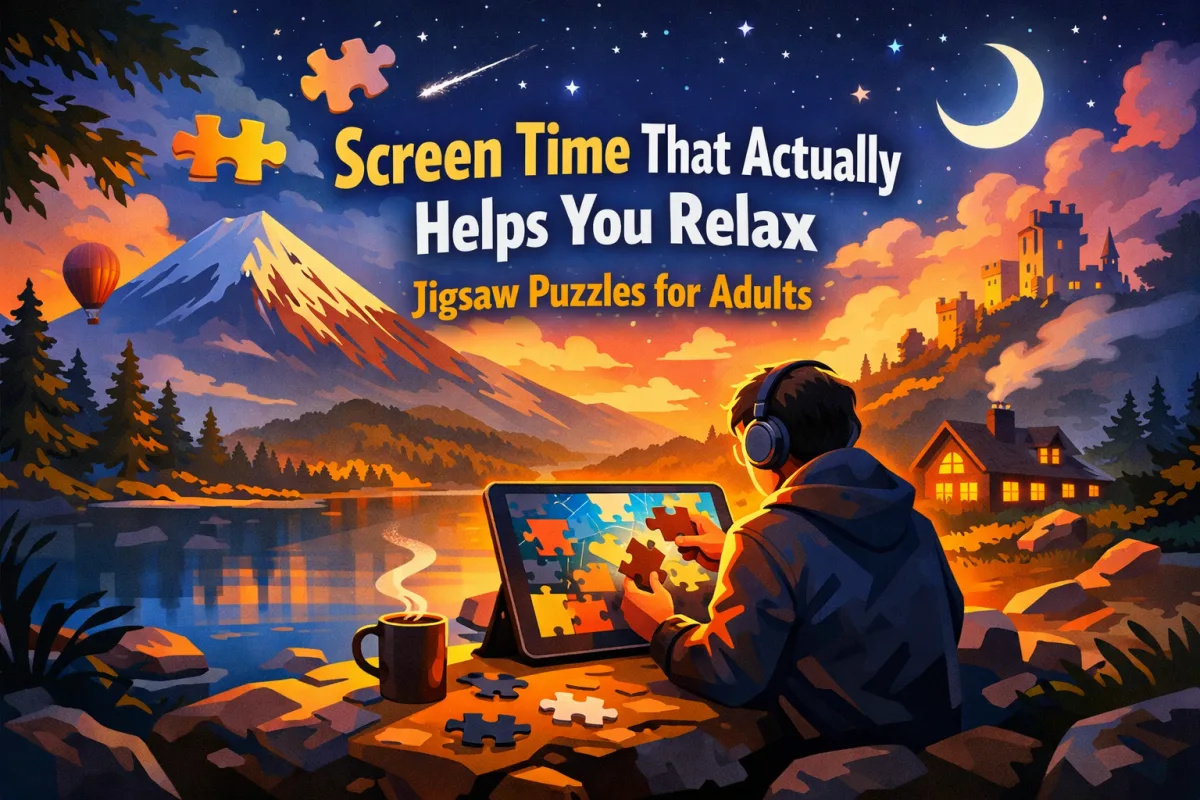
Rethinking Screen Time for Adults
Screen time is often treated as one negative habit, but it includes very different types of mental activity. Scrolling social feeds, watching short clips, and reacting to notifications keep the brain in a fast, fragmented mode.
Some digital activities do the opposite: they slow attention down, reduce mental noise, and help you recover. A jigsaw puzzle on a screen is one of the clearest examples of “calming screen time” because it has structure, boundaries, and an endpoint.
What a Digital Jigsaw Puzzle Is (as an Entity)
A digital jigsaw puzzle is a structured visual reconstruction task: you rebuild a complete image by placing fragmented pieces using pattern recognition, spatial reasoning, and short-term memory. It is not “content to consume.” It is an interactive system with rules, feedback, and measurable progress.
Adults often find it relaxing because the task is engaging enough to hold attention, but gentle enough to avoid overload.
Key Properties That Make It Relaxing
- Single focus loop: find piece → test fit → place → repeat.
- Low urgency: no timer pressure unless you add it.
- Visible progress: your brain can “see” order increasing.
- Finite structure: it ends, so it doesn’t turn into endless scrolling.
“Relaxation isn’t always doing nothing. Sometimes it’s doing one quiet thing on purpose.”
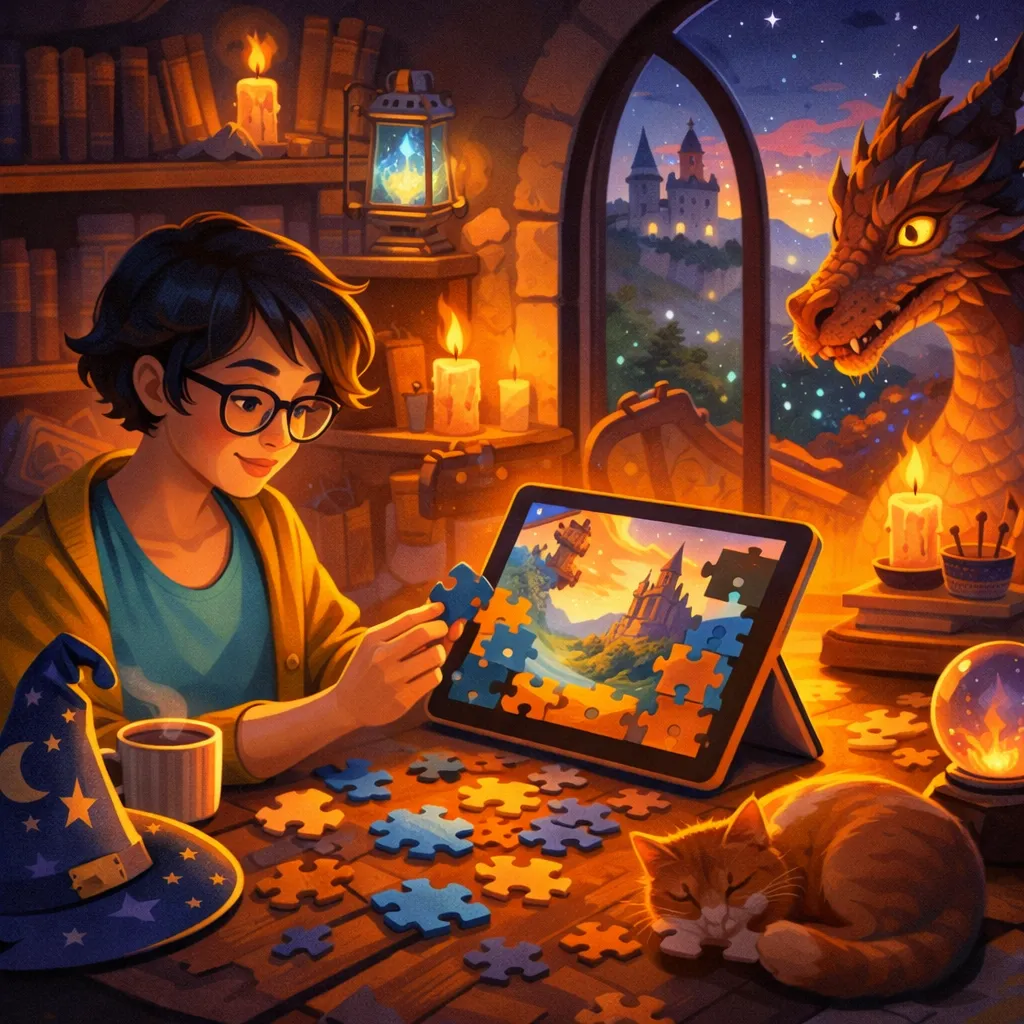
Why Puzzles Feel Calming: The Semi-Technical Explanation
Jigsaw solving recruits several cognitive systems at a moderate intensity: visual search, pattern matching, and spatial alignment. This combination can create a “flow-like” state where attention becomes stable and distractions fade.
Unlike social media, the puzzle does not constantly switch context. That matters because frequent context switching increases cognitive load and can keep you mentally activated even when you’re physically resting.
What Your Brain Is Doing During a Puzzle
- Visual filtering: scanning for edges, colors, textures, and shapes.
- Working memory: holding a small “piece candidate list” in mind.
- Error-friendly learning: misfits are cheap, quick, and harmless.
- Reward signaling: small wins from correct placement reinforce calm persistence.
Digital vs Physical Jigsaw Puzzles
Both formats share the same core task, but the experience differs. Digital puzzles reduce setup friction and mess, while physical puzzles add tactile feedback and a stronger “offline” feeling.
| Aspect | Digital Jigsaw | Physical Jigsaw |
|---|---|---|
| Setup & storage | Instant start, no table needed | Requires space and ongoing setup |
| Tactile feedback | Minimal (tap/drag) | High (touch, grip, physical fit) |
| Distraction risk | Higher if notifications are on | Lower (no device pings) |
| Accessibility | Zoom, hints, piece sorting tools | Depends on lighting and vision comfort |
| Clean finish | One tap to save/close | Cleanup or permanent display required |
How to Use Jigsaw Puzzles as “Helpful Screen Time”
If your goal is relaxation, you want to design the session so it behaves like a recovery ritual, not a productivity sprint. Small changes in setup make a big difference.
Step 1: Remove the “Alert Layer”
- Enable Do Not Disturb or Focus mode.
- Use full-screen mode to avoid multitasking.
- Lower brightness slightly and avoid harsh blue light late at night.
Step 2: Pick a Puzzle That Matches Your Energy
Relaxation improves when challenge matches your current mental bandwidth. Too easy becomes boring; too hard becomes tense.
| Your current state | Best choice | Why it works |
|---|---|---|
| Very tired | 60–120 pieces, clear image | Quick wins, low strain |
| Normal evening | 150–300 pieces, moderate detail | Stable focus without frustration |
| Weekend deep unwind | 300–600 pieces, rich scenery | Longer flow state, stronger immersion |
| High stress day | Edge-first strategy puzzle | Strong structure reduces mental noise |
Step 3: Use Simple Techniques to Keep It Calm
Start with edges and “easy clusters”
Edges create a stable frame. Clusters (sky, buildings, faces, patterns) reduce search space and keep progress visible.
Limit session length on weekdays
For many adults, 10–25 minutes is enough to shift the nervous system from “reactive” to “settled” without sacrificing sleep.
Avoid competitive metrics when you want recovery
Timers, leaderboards, and performance comparisons can be fun, but they change the emotional tone. If relaxation is the goal, prioritize a gentle pace.
Useful Features to Look For in a Digital Puzzle Platform
Different puzzle apps and websites implement the same concept with different tools. The best “relaxation-first” experience usually includes assistive features that reduce friction without removing the core challenge.
- Adjustable piece count (so you can match difficulty to energy)
- Zoom and pan (especially on smaller screens)
- Piece sorting (by color, edge, or region)
- Optional hints (light guidance, not full automation)
- Autosave (so you can stop without “losing the calm”)
For example, PuzzleFree.Game can be used as a platform to try digital jigsaw puzzles with adjustable difficulty, but the key idea applies to any similar service: the calmer the interface and the fewer interruptions, the more restorative the session.
Common Mistakes That Make Puzzle Screen Time Less Relaxing
- Keeping notifications on: even one ping breaks the calming loop.
- Choosing a puzzle that is too hard late at night: frustration raises arousal.
- Using the puzzle as “background” while doing other tasks: multitasking removes the flow benefit.
- Playing under harsh lighting or high brightness: eye strain feels like stress.
A Simple “Relaxation Protocol” You Can Reuse
If you want puzzle sessions to reliably calm you down, keep a repeatable setup. Consistency turns it into a mental cue: when you start, your brain knows it’s safe to slow down.
- Activate Do Not Disturb.
- Pick 150–300 pieces (or lower if tired).
- Edges first, then 1–2 easy clusters.
- Stop at a natural milestone (frame done, one region complete).
Takeaway
Jigsaw puzzles for adults are not just “a game on a screen.” They are a structured attention tool: a calm, finite activity that replaces fragmented scrolling with steady focus and visible progress. When you remove notifications and choose a sensible difficulty, puzzle-based screen time can act as a practical, repeatable way to relax.