PuzzleFree
Types of Puzzles: Complete Guide to Puzzle Categories
February 9, 2026
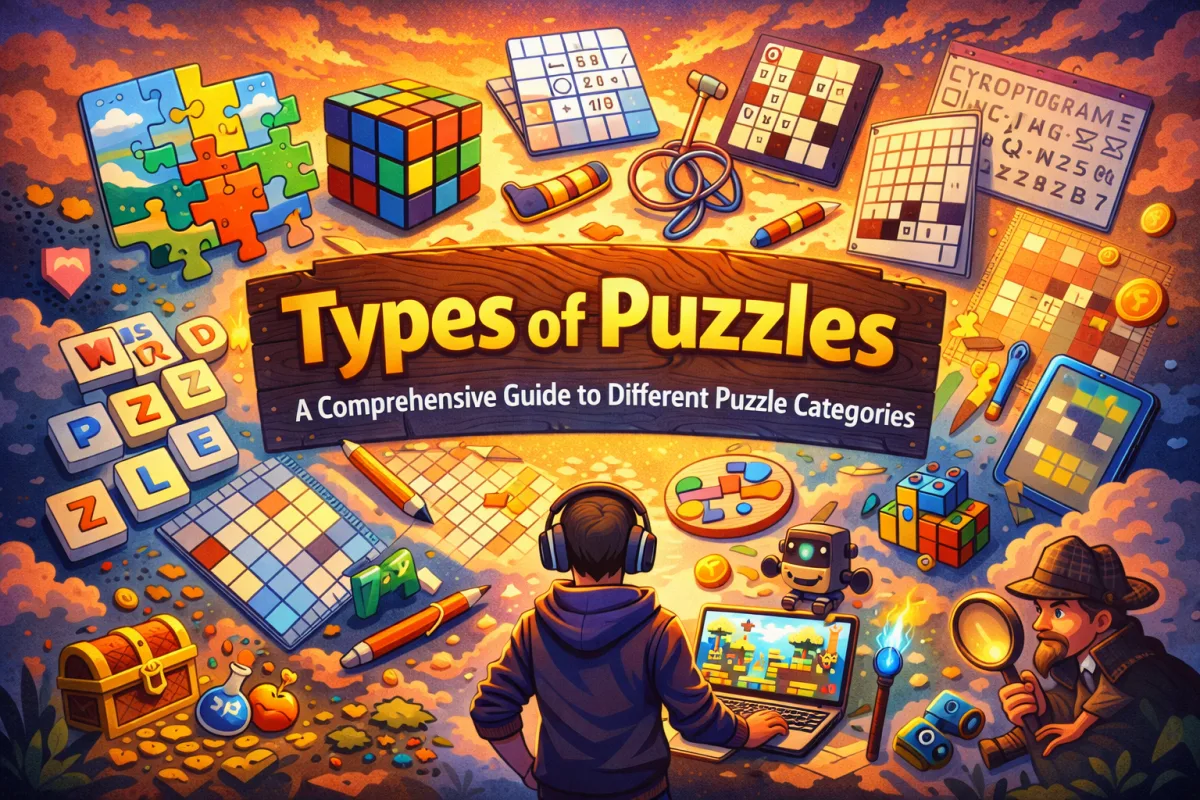
Puzzles offer a rich tapestry of challenges across numerous formats, rules, and interaction styles. From the tactile experience of assembling jigsaw pieces to the mental acrobatics of solving logic problems, puzzles engage our minds in unique ways. These diverse problem-solving activities span physical manipulatives, paper-based formats, and digital experiences, each providing distinct cognitive benefits while entertaining puzzle enthusiasts of all ages.
Understanding Puzzle Categories and Their Benefits
The world of puzzles encompasses a vast array of categories, each with its own set of rules, objectives, and cognitive demands. From ancient mechanical challenges to modern digital experiences, puzzles have evolved significantly throughout human history while maintaining their fundamental appeal as problem-solving activities.
Puzzles aren't simply entertainments; they serve as tools for cognitive development across various mental functions. Word puzzles build vocabulary and linguistic processing, while mathematical puzzles sharpen numerical reasoning. Logic puzzles enhance deductive thinking, and mechanical puzzles improve spatial awareness and fine motor coordination. This diversity means different puzzle types can target specific cognitive skills based on their structure and solving requirements.
The categorization of puzzles has shifted over time. Early puzzle categories focused primarily on physical manipulatives and paper-based challenges. With technological advances, digital categories have emerged, blurring traditional boundaries and creating hybrid experiences. Yet the core categories—jigsaw, word, number, logic, mechanical, and digital—remain recognizable frameworks for understanding the puzzle landscape.
Physical vs. Mental Puzzles
The puzzle universe divides broadly into physical and mental categories, each engaging different cognitive and sensory systems. Physical puzzles, including mechanical puzzles like the Rubik's Cube or wooden block assemblies, require hands-on manipulation of objects. They involve spatial reasoning and develop fine motor skills through the physical handling of pieces, creating a tactile dimension to problem-solving.
Mental puzzles, by contrast, exist primarily as concepts to be solved through cognitive processing rather than physical manipulation. Crosswords, Sudoku, and logic problems fall into this category, focusing on abstract thinking and pattern recognition rather than physical dexterity.
- Physical puzzles: Involve tactile experience, develop spatial reasoning, improve fine motor coordination, provide immediate feedback
- Mental puzzles: Focus on abstract thinking, enhance pattern recognition, strengthen working memory, often require minimal or no physical components
These categories aren't strictly separate—many puzzles incorporate both physical and mental elements to varying degrees. The balance between these components often determines which learning styles and personality types will find a particular puzzle most engaging.
Jigsaw Puzzles: More Than Pieces in a Box
Jigsaw puzzles represent perhaps the most recognizable puzzle format worldwide, with their distinctive interlocking pieces and visual assembly objectives. Their origins trace back to the 1760s when mapmaker John Spilsbury created the first dissection puzzle by mounting a map on wood and cutting along country borders. From these educational beginnings, jigsaws evolved into entertainment objects, transitioning from hand-cut wooden pieces to mass-produced cardboard varieties.
The appeal of jigsaw puzzles lies partly in their accessibility—almost anyone can understand the objective of assembling a complete image from fragments. Yet beneath this simplicity lies a sophisticated cognitive workout. As we manipulate pieces, our brains engage in constant spatial reasoning, pattern matching, and hypothesis testing. Fine motor skills develop through the precise handling of pieces, while visual processing improves as we analyze color patterns and shapes.
Jigsaws also stand out for their scalable difficulty. A simple 25-piece puzzle suits young children developing basic spatial concepts, while advanced puzzlers might tackle 5,000+ piece challenges requiring weeks of dedication. This adaptability has helped jigsaw puzzles remain relevant across centuries of changing entertainment options.
From Traditional to Innovative: Jigsaw Puzzle Variations
The classic flat cardboard jigsaw represents just one point on a spectrum of increasingly innovative puzzle designs. Modern manufacturers have pushed boundaries in materials, construction methods, and solving experiences, creating entirely new subcategories within the jigsaw family.
Wooden puzzles have experienced a renaissance, with artisanal makers creating pieces featuring whimsical shapes called "whimsies" that often relate thematically to the puzzle image. Companies like Liberty Puzzles and Artifact Puzzles have revived traditional craftsmanship using laser-cutting technology to create intricate wooden pieces with distinctive tactile qualities far removed from mass-market cardboard puzzles.
Three-dimensional jigsaw puzzles transform the flat assembly experience into architectural models, globes, or sculptural objects. These 3D challenges add structural considerations to the traditional matching process—pieces must connect correctly and maintain structural integrity as the model takes shape.
Gradient jigsaw puzzles represent another innovation, eliminating recognizable images entirely in favor of subtle color transitions that make assembly extraordinarily challenging. Without distinct visual reference points, solvers must rely almost exclusively on shape recognition and minute color differentiation.
- 3D jigsaw puzzles (architectural landmarks, spherical globes, sculptural objects)
- Wooden puzzles with artisanal "whimsie" pieces and unique cutting patterns
- Gradient or pattern puzzles featuring color transitions rather than distinct images
- Double-sided puzzles with different images on each side
- Mystery puzzles that don't provide reference images for the final picture
- Floor puzzles designed for group assembly and larger scale
- Custom photo puzzles featuring personal images
Flat 2D Jigsaw Puzzles
Traditional flat jigsaw puzzles remain the most popular format despite the rise of innovative variations. These puzzles typically feature cardboard pieces cut into interlocking shapes that assemble into a rectangular image. Their enduring appeal stems partly from their affordability, portability, and the satisfying tactile experience of connecting pieces correctly.
The difficulty of flat jigsaws correlates primarily with piece count, though image complexity plays a significant role as well. Puzzles with large areas of similar color or pattern (like blue skies or green foliage) present greater challenges than those with distinct visual elements. Subject matter spans virtually everything imaginable—from famous artworks and photographs to fantasy scenes, maps, and nostalgic imagery.
| Piece Count | Difficulty Level | Approximate Time | Best For |
|---|---|---|---|
| 25-100 | Beginner | 30-60 minutes | Young children, beginners |
| 300-500 | Intermediate | 3-5 hours | Casual puzzlers |
| 1000 | Standard | 8-15 hours | Experienced puzzlers |
| 2000+ | Advanced | 20+ hours | Dedicated enthusiasts |
Floor and Mega Jigsaw Puzzles
Floor puzzles and mega jigsaws transform the typically intimate puzzle experience into something more expansive, often requiring dedicated space and extended time commitments. Floor puzzles, designed primarily for children, feature oversized pieces that spread across play areas and resist damage from enthusiastic young hands. Their large format makes them ideal for group play, encouraging collaborative problem-solving among siblings or classmates.
Mega puzzles represent the extreme end of the jigsaw spectrum, with piece counts ranging from 3,000 to over 40,000. These massive undertakings demand significant space—often a dedicated table or room where the puzzle can remain undisturbed for weeks or months. The current record-holder for the world's largest commercially available puzzle contains 54,000 pieces and measures over 28 feet wide when completed.
Working on mega puzzles requires specialized strategies for organization. Many enthusiasts sort pieces by color or pattern into separate containers, essentially breaking down the mammoth task into manageable sections. Some use foam board or puzzle mats to create movable sections that can be stored vertically when not in use, addressing the practical space limitations most homes face with such expansive projects.
Murder Mystery and Themed Puzzles
Murder mystery puzzles blend traditional jigsaw assembly with narrative storytelling, creating a hybrid experience that engages both visual-spatial skills and deductive reasoning. These puzzles typically include a short story describing a fictional crime, with clues hidden within the puzzle image itself. The completed puzzle often reveals additional visual information not apparent from the box illustration, helping solvers unravel the mystery.
Beyond murder mysteries, themed puzzle series create collectible experiences for enthusiasts with specific interests. Fantasy worlds, historical periods, famous artists, and travel destinations all inspire dedicated puzzle lines. Some companies have created subscription services delivering themed puzzles monthly, often with connected narratives or collecting incentives.
These enhanced puzzles transform the solitary activity of jigsaw assembly into something more immersive and story-driven. Companies like Ravensburger and Buffalo Games have partnered with mystery authors to create compelling narratives that complement their puzzle images. The satisfaction comes not just from completing the image but from solving the associated mystery, making the experience more intellectually engaging than standard jigsaws.
Word Puzzles: Challenges for Language Lovers
Word puzzles harness the rich complexity of language to create cognitive challenges that entertain while building vocabulary and linguistic processing skills. Unlike puzzles that focus on spatial relationships or mathematical principles, word puzzles specifically target our verbal intelligence, demanding facility with spelling, word recognition, and semantic relationships.
The cognitive benefits of regular word puzzle solving extend beyond simple entertainment. Research suggests consistent engagement with word puzzles correlates with expanded vocabulary, improved spelling, and faster word retrieval. For language learners, these puzzles provide practical application of vocabulary in context. Word puzzles also exercise mental flexibility as we manipulate letters, rearrange sequences, and recognize patterns within language structures.
The history of word puzzles stretches back centuries, with early crosswords appearing in 19th-century children's books. The first published crossword puzzle as we know it today appeared in the New York World newspaper on December 21, 1913, created by journalist Arthur Wynne. From these beginnings, word puzzles have evolved into diverse formats with varying levels of complexity, from simple word searches suitable for children to cryptic crosswords that challenge even the most sophisticated language users.
The accessibility of word puzzles makes them particularly appealing across demographics. Many require only pen and paper, making them available regardless of economic circumstances. Their adaptability also means they can be calibrated for different skill levels, from elementary school vocabulary to specialized professional terminology, allowing puzzlers to find appropriate challenges throughout their lives.
Crosswords and Beyond: Word Puzzle Diversity
The universe of word puzzles extends far beyond the familiar crossword grid, encompassing diverse formats that challenge different aspects of linguistic ability. Each type presents unique cognitive demands, from simple word recognition to complex code-breaking and inferential reasoning.
Standard American crosswords feature a grid of white squares separated by black squares, with words reading across and down. Clues typically offer straightforward definitions or obvious wordplay. In contrast, British-style cryptic crosswords provide clues containing both wordplay and definition elements, requiring solvers to decipher the clue structure itself before determining the answer.
Word searches represent a more accessible format where players locate hidden words in a grid of letters. These words may run horizontally, vertically, diagonally, forward, or backward, exercising visual scanning and pattern recognition. Anagrams challenge players to rearrange given letters to form new words, developing letter-pattern recognition and mental flexibility.
Cryptograms present encoded text where each letter has been substituted with another letter consistently throughout the puzzle. Solving requires frequency analysis and pattern recognition to decode the substitution key. Rebuses use pictures, symbols, and letters in combination to represent words or phrases, demanding creative interpretation of visual elements.
| Puzzle Type | Difficulty Level | Skills Developed | Best For |
|---|---|---|---|
| Word Search | Easy to Moderate | Visual scanning, pattern recognition | Beginners, casual solvers |
| Standard Crossword | Moderate | Vocabulary, general knowledge | Regular puzzlers with broad knowledge |
| Anagrams | Moderate | Letter pattern recognition, spelling | Word enthusiasts |
| Cryptogram | Challenging | Pattern analysis, deductive reasoning | Logical thinkers, code enthusiasts |
| Cryptic Crossword | Very Challenging | Lateral thinking, wordplay recognition | Experienced word puzzlers |
| Rebus | Varies | Visual-verbal connections, creative thinking | Visual thinkers |
Cryptogram Puzzles
Cryptogram puzzles transform ordinary text into encoded messages through consistent letter substitution, challenging solvers to crack the code and reveal the hidden message. Each letter in the original text is replaced with a different letter throughout the entire puzzle, creating a substitution cipher that maintains the original word patterns and letter frequencies.
The solving process typically begins with frequency analysis—identifying common letters like E, T, A, and O based on their statistical prevalence in English. Short words offer important clues; common three-letter words like "the" and "and" provide anchors for decoding. As letters are identified, patterns emerge that help reveal additional letters, gradually unlocking the message.
Unlike modern cryptography, which aims for unbreakable security, cryptograms are designed to be solvable through analytical thinking. They connect to the historical practice of cryptography, from ancient Roman ciphers to more sophisticated encoding methods developed during wartime. Cryptoquips represent a popular variation featuring witty quotes or observations, often including a hint by revealing one letter's identity at the start.
Q KZW GIYL HZWGY ZL HZWGY KZW, VWL Q KZW GIYL LYKKQ LZ HZWGL, LBYL'H GZWY LBYT HQGPSY SFMK.
Rebus Puzzles
Rebus puzzles blend visual and verbal elements to represent words, phrases, or sayings through a combination of images, letters, symbols, and their spatial arrangements. The name "rebus" comes from Latin, meaning "by things"—an apt description for puzzles that use pictures and symbols to stand for words or syllables.
These puzzles require flexible thinking that bridges visual and verbal processing. Solvers must interpret visual elements not just for what they depict but for what they represent linguistically. A picture of an eye might represent the word "I" or "eye," while the positioning of text (such as the word "standing" written above the word "I") creates the phrase "standing over I" or "understanding."
Historical examples of rebuses date back centuries, appearing in heraldic designs and early printed books. Today's rebuses range from simple children's puzzles to sophisticated brain teasers that combine multiple visual and verbal tricks. Digital formats have expanded possibilities, allowing for animated elements and interactive features that weren't possible in traditional print forms.
Examples:
KNEE + LIGHT = "Kneelight" (Moonlight)
M/R = "M over R" (Empower)
STAND = "I understand" (I under Stand)
Number and Logic Puzzles: Mathematical Challenges
Number and logic puzzles represent a distinct category of problem-solving challenges that engage mathematical reasoning and deductive thinking. Unlike word or jigsaw puzzles, these challenges involve structured systems of rules and constraints, requiring solvers to apply careful analysis rather than relying on general knowledge or pattern matching.
These puzzles span a wide difficulty spectrum. Simple arithmetic puzzles may involve basic operations and number placement, while advanced logic problems might require sophisticated deductive techniques and formal logical reasoning. This range makes them accessible entry points for beginners while offering sufficient complexity to challenge experts.
The cognitive benefits of number and logic puzzles include enhanced critical thinking, improved pattern recognition, and strengthened analytical skills. By working with numerical relationships and logical constraints, solvers develop structured approaches to problem-solving that transfer to real-world situations. These puzzles also build mental discipline by requiring sustained focus and systematic elimination of possibilities.
Educational settings frequently incorporate these puzzles to develop mathematical fluency and logical reasoning in students. From elementary classrooms to university mathematics departments, number and logic puzzles provide engaging applications of abstract concepts. They make mathematical thinking accessible and enjoyable, helping students recognize patterns and relationships without the pressure of formal problem sets.
- Simple logic grid puzzles: Using elimination to match items in different categories based on given clues
- Sudoku variations: Placing numbers according to specific constraints across rows, columns, and regions
- Kakuro and KenKen: Combining number placement with arithmetic operations
- Nonograms: Using numerical clues to create pixel art through logical deduction
- Complex deduction problems: Knights and knaves puzzles, Einstein's riddle, and other multi-step logical challenges
Sudoku and Its Relatives
Sudoku emerged as a global phenomenon in the early 2000s, though its roots trace back to 18th-century Swiss mathematics and 20th-century puzzle magazines. The standard form presents a 9×9 grid partially filled with numbers. Players must complete the grid so each row, column, and 3×3 box contains the digits 1 through 9 without repetition. Despite using numbers, Sudoku requires no mathematical calculation—it's purely a logic puzzle using numerical symbols.
Solving techniques range from simple "scanning" (checking rows, columns, and boxes for missing numbers) to more sophisticated approaches like "pointing pairs" and "X-wing patterns" that identify hidden constraints. Expert solvers develop the ability to recognize these patterns quickly, allowing them to tackle increasingly difficult puzzles.
Kakuro presents a different challenge, combining number placement with addition. In these puzzles, players fill blank cells with numbers that sum to specified totals for each row and column. Unlike Sudoku, Kakuro requires actual arithmetic, adding a mathematical dimension to the logical deduction.
KenKen extends this concept further by incorporating multiple operations—addition, subtraction, multiplication, and division. Created by Japanese mathematics teacher Tetsuya Miyamoto, KenKen puzzles specify both the operation and the result for groups of cells called "cages." This format develops both computational fluency and logical thinking.
Other variations include Killer Sudoku (combining Sudoku rules with Kakuro-like sum constraints), Samurai Sudoku (five overlapping Sudoku grids), and Mini Sudoku (smaller 6×6 or 4×4 grids for quicker solving).
Logic Puzzles and Riddles
Pure logic puzzles remove mathematical operations entirely, focusing instead on deductive reasoning through verbal scenarios and constraints. These puzzles present a situation with limited information and ask solvers to determine a complete solution through systematic analysis.
Grid-based logic puzzles represent a common format where solvers match items in different categories based on given clues. For example, a puzzle might describe five people with different occupations living in different colored houses, then provide relational clues like "The doctor lives next to the blue house." Solving requires creating a grid to track possibilities and systematically eliminating contradictions until only one solution remains.
Knights and knaves puzzles, popularized by logician Raymond Smullyan, feature characters where knights always tell the truth and knaves always lie. Solvers must determine who's who based on statements the characters make, often involving self-reference or statements about other characters. These puzzles highlight fundamental logical principles about truth values and inconsistency.
Einstein's Puzzle (sometimes called the Zebra Puzzle) presents five houses with residents of different nationalities, who own different pets, drink different beverages, and so forth. Through logical deduction from given clues, solvers must determine who owns the zebra. Similar constraint-satisfaction problems include river-crossing puzzles where items must be transported across a river following specific rules.
Mechanical Puzzles: Hands-On Problem Solving
Mechanical puzzles engage our minds through physical manipulation, creating a tangible problem-solving experience distinct from paper or digital challenges. These three-dimensional objects typically require assembly, disassembly, rearrangement, disentanglement, or sequential movement to reach a solution state.
The history of mechanical puzzles stretches back thousands of years. Archaeological evidence suggests ancient civilizations from China to Greece created mechanical puzzles from available materials. The Chinese tangram puzzle dates to the Song Dynasty (960-1279 CE), while interlocking wooden puzzles appear in historical records across many cultures. Today's mechanical puzzles range from mass-produced plastic versions to hand-crafted artisanal pieces made from exotic woods and metals.
Unlike purely mental challenges, mechanical puzzles engage spatial reasoning and fine motor skills simultaneously. They provide immediate tactile feedback as manipulations either succeed or fail, creating a direct physical connection to the problem-solving process. This hands-on quality makes them particularly valuable for kinesthetic learners who process information best through physical interaction.
The craftsmanship involved in creating mechanical puzzles has developed into an art form. Master puzzle makers like Stewart Coffin and Oskar van Deventer have designed pieces that combine mathematical principles with aesthetic beauty, creating objects that function as both puzzles and decorative art.
- Twisty puzzles: Rubik's Cube and related puzzles with rotating sections
- Disentanglement puzzles: Interlinked pieces that must be separated without force
- Assembly/disassembly puzzles: Three-dimensional challenges requiring specific construction or deconstruction
- Sequential movement puzzles: Sliding block puzzles like Rush Hour or the 15-puzzle
- Dexterity puzzles: Challenges requiring physical skill and coordination
- Puzzle boxes: Containers with hidden mechanisms that must be discovered to open
Cube Puzzles: From Rubik's to Beyond
The Rubik's Cube stands as perhaps the most recognizable mechanical puzzle ever created, having sold hundreds of millions of units since its invention by Hungarian professor Ernő Rubik in 1974. Originally called the "Magic Cube," this simple-looking object—a 3×3×3 cube with colored stickers on each face—creates extraordinary complexity through its internal mechanism allowing each face to rotate.
The mathematical principles behind the Rubik's Cube are fascinating. With 43 quintillion possible arrangements but only one solved state, it represents a challenge in group theory and combinatorics. Basic solving methods typically involve a layer-by-layer approach, while advanced "speedcubers" use algorithms optimized for efficiency, allowing them to solve the puzzle in mere seconds. The current world record stands at under 4 seconds.
From the original 3×3×3 cube, an entire family of twisty puzzles has evolved. The Rubik's Revenge (4×4×4) adds complexity by including internal pieces without fixed centers. The Professor's Cube (5×5×5) extends this further. The Rubik's Magic consists of eight square tiles connected by filament, challenging solvers to fold it into specific patterns.
Beyond the official Rubik's brand, numerous variations have emerged. The Pyraminx, a tetrahedron-shaped puzzle created by Uwe Mèffert, features triangular faces that rotate around fixed vertices. The Megaminx expands the cube concept to a dodecahedron with 12 faces. The Mirror Cube maintains the 3×3×3 mechanism but replaces color differentiation with shape differences, creating a three-dimensional challenge even when solved.
Other innovations include the Square-1 (which changes shape as it's manipulated), the Gear Cube (with interlocking geared edges), and the Ghost Cube (an extremely challenging shape modification of the 3×3×3).
Disentanglement and Wire Puzzles
Disentanglement puzzles present a deceptively simple challenge: separate interlinked pieces without using force. Typically constructed from wire, rope, or wood, these puzzles exploit topological principles and spatial reasoning to create arrangements that appear impossible to separate yet contain hidden movement paths that allow solution.
Wire puzzles represent one of the oldest puzzle formats, with examples dating back centuries across different cultures. Traditional designs include the Chinese ring puzzle (also known as the Baguenaudier or "patience puzzle"), consisting of a series of rings attached to a loop that must be removed from a handle through a specific sequence of moves.
Modern wire puzzles range from simple two-piece challenges to complex arrangements with multiple components. Their difficulty stems from the need to visualize movements in three dimensions and understand how apparently solid barriers can be bypassed through precise manipulation. Some require dozens or even hundreds of steps performed in exact sequence to achieve separation.
The solving process typically involves careful exploration of possible movements, identifying constraints, and gradually building an understanding of the puzzle's internal structure. Unlike many puzzles that can be solved through systematic trial and error, disentanglement puzzles often require moments of insight when the solver suddenly recognizes the key movement that enables progress.
Puzzle Boxes and Sequential Discovery
Puzzle boxes challenge solvers to discover hidden mechanisms that allow access to internal compartments. Unlike conventional containers with obvious locking mechanisms, puzzle boxes conceal their opening methods, requiring exploration, deduction, and sometimes counterintuitive manipulations to solve.
Traditional Japanese puzzle boxes, known as Himitsu-Bako or "secret boxes," represent a centuries-old craft originating in the Hakone region. These wooden boxes open through precise sequences of sliding panels, with more complex examples requiring 50+ moves in exact order. The craftsmanship involves intricate joinery techniques using different wood types to create nearly invisible seams and mechanisms.
Modern sequential discovery puzzles have elevated this concept to new levels of complexity. These puzzles often require finding and using hidden tools within the puzzle itself to progress through multiple stages. For example, a puzzle might conceal a small magnetic tool that, once discovered, helps manipulate internal components to unlock the next phase. Renowned puzzle designers like Jean Claude Constantin and Eric Fuller create these multi-step challenges that blend mechanical ingenuity with logical progression.
The solving experience combines tactile exploration, deductive reasoning, and memory as solvers must recall previous states and discoveries. High-quality puzzle boxes can command prices from hundreds to thousands of dollars, creating a specialized collectors' market for particularly innovative or beautifully crafted examples.
Digital and Online Puzzles: Modern Evolution
Digital technology has fundamentally transformed puzzle experiences, both by adapting traditional formats to electronic platforms and by creating entirely new puzzle types impossible in physical form. This evolution has expanded the accessibility, variety, and interactive potential of puzzles while maintaining their core cognitive benefits.
The adaptation of classic puzzles to digital formats offers numerous advantages. Digital jigsaws eliminate lost pieces and space constraints while adding features like automatic sorting, progressive hints, and adjustable difficulty. Online crosswords provide immediate feedback, clue explanations, and unlimited content. Number puzzles like Sudoku can verify entries as you go, helping beginners learn solving techniques.
Beyond simple adaptation, technology has enabled entirely new puzzle concepts. Physics-based puzzles like Cut the Rope or Portal use simulated physical properties as core mechanics. Pattern recognition games like The Witness create environments where the puzzles themselves form an integrated world. Augmented reality applications blend physical spaces with digital puzzle elements, creating hybrid experiences.
The social dimension of puzzles has also evolved through digital platforms. Online communities share solutions, create custom content, and compete in puzzle-solving competitions. Multiplayer puzzle games allow real-time collaboration or competition regardless of physical location. This connectivity has transformed what was traditionally a solitary activity into potentially rich social experiences.
- Infinite variety and difficulty levels: Digital puzzles can generate new content algorithmically or through vast libraries
- Immediate feedback and hints: Systems can provide assistance calibrated to player needs
- No lost pieces or setup time: Digital formats eliminate physical management concerns
- Social and competitive elements: Online leaderboards, multiplayer options, and sharing capabilities
- Accessibility features: Customizable interfaces for different visual, motor, or cognitive needs
- Portable puzzle collection: Hundreds of puzzles available on a single device
App-Based Puzzle Games
Mobile devices have become the primary platform for digital puzzle experiences, with app stores offering thousands of puzzle games spanning every conceivable category. This explosion of content has transformed puzzles from occasional activities to ever-present options for mental engagement during brief moments of downtime.
App-based puzzles leverage the unique capabilities of smartphones and tablets—touch screens enable intuitive manipulation, accelerometers allow motion-based puzzles, and cameras facilitate augmented reality experiences. These technologies create puzzle interactions impossible in traditional formats, such as physically tilting the device to guide objects through mazes or using the camera to transform real environments into puzzle spaces.
Many app-based puzzles incorporate sophisticated progression systems that adapt to player skill. Rather than static difficulty levels, these games analyze solving patterns and adjust challenge accordingly. This adaptive approach maintains an optimal balance between frustration and achievement, keeping players engaged longer than fixed-difficulty puzzles.
The business models of puzzle apps vary widely, affecting their design and player experience. Premium apps offer complete experiences for a one-time purchase, while free-to-play models may incorporate advertising or microtransactions. When evaluating puzzle apps, consider whether monetization systems enhance or detract from the core puzzle experience.
-
Daily puzzle collections and routine-based challenges
(daily jigsaws, rotating categories, progress-based collections — including PuzzleFree) -
Narrative puzzle adventures
(story-driven puzzle worlds such as Monument Valley or The Room series) -
Augmented reality puzzle experiences
(location-based or camera-enhanced puzzles, e.g. Pokémon GO–style mechanics) -
Social and competitive puzzle platforms
(shared solving, rankings, multiplayer formats like Words with Friends–type systems) -
Adaptive difficulty puzzle systems
(puzzles that scale complexity dynamically based on user behavior, similar to Threes! or 2048 mechanics) -
Subject-focused and educational-style puzzle apps
(logic, math, or pattern-based puzzles inspired by platforms like DragonBox or Pythagorea)
Optical Illusion Puzzles
Optical illusion puzzles exploit the gap between physical reality and our perception of it, creating challenges that force us to question what we see. These puzzles reveal how our visual processing systems make assumptions, fill in missing information, and sometimes misinterpret visual data.
Hidden object puzzles represent a common format, challenging viewers to locate concealed elements within complex images. The difficulty arises from how our visual system prioritizes obvious patterns and familiar objects, allowing cleverly disguised elements to hide in plain sight. Figure-ground puzzles play with the relationship between positive space (figures) and negative space (ground), creating images with dual interpretations, such as the classic face/vase illusion.
Impossible objects present apparent contradictions that cannot exist in three-dimensional space, such as the Penrose triangle or endless staircases. These illusions exploit how we interpret two-dimensional representations of three-dimensional objects, creating apparent paradoxes that challenge our spatial reasoning.
Ambiguous images can be interpreted in multiple ways depending on how the viewer processes the visual information. The duck/rabbit illusion, for example, can be seen as either animal depending on which features the viewer focuses on. Solving these puzzles often requires mental flexibility—the ability to consciously shift perspective and see alternative interpretations of the same visual data.
Educational and Developmental Puzzles
Educational puzzles serve as powerful tools for cognitive development, offering structured challenges that build specific skills while maintaining engagement through play. Unlike purely recreational puzzles, these are designed with intentional learning outcomes, though the line between education and entertainment often blurs.
Research consistently supports the value of puzzle-based learning across developmental stages. For young children, shape sorters and simple jigsaw puzzles build fundamental spatial awareness and fine motor coordination. School-age children benefit from word puzzles that reinforce vocabulary and spelling, while mathematical puzzles strengthen numerical reasoning. For adolescents and adults, complex logic and strategic puzzles develop critical thinking and executive function skills.
The effectiveness of educational puzzles stems from their self-correcting nature—incorrect solutions simply don't work, providing immediate feedback without external judgment. This encourages independent problem-solving and resilience through trial and error. Additionally, the satisfaction of solving creates intrinsic motivation, making learning feel less like work and more like play.
Educators and developmental specialists select puzzles based on both content relevance and appropriate challenge level. A puzzle must be difficult enough to require effort but not so challenging that it creates frustration. This balance—what psychologist Lev Vygotsky called the "zone of proximal development"—creates optimal conditions for learning and skill acquisition.
| Age Group | Recommended Puzzles | Primary Skills Developed | Secondary Benefits |
|---|---|---|---|
| 0-2 years | Knob puzzles, simple shape sorters | Grasp reflex, object permanence | Cause-effect understanding |
| 2-4 years | Chunky jigsaws, basic pattern matching | Fine motor coordination, shape recognition | Task persistence, spatial awareness |
| 4-7 years | 24-100 piece jigsaws, simple word puzzles | Visual discrimination, basic literacy | Planning skills, letter recognition |
| 7-11 years | Word searches, number puzzles, 300+ piece jigsaws | Spelling, basic math operations | Concentration, systematic thinking |
| 11-16 years | Logic problems, cryptograms, strategy puzzles | Deductive reasoning, pattern analysis | Patience, abstract thinking |
| 16+ years | Complex jigsaws, cryptic crosswords, advanced logic | Strategic planning, linguistic analysis | Stress reduction, cognitive flexibility |
Montessori-Inspired Puzzles
Montessori-inspired puzzles reflect the educational philosophy developed by Maria Montessori, emphasizing self-directed learning through carefully designed materials. These puzzles embody key Montessori principles: they're self-correcting (incorrect solutions simply don't work), isolate specific concepts, progress from simple to complex, and engage multiple senses.
Unlike many commercial puzzles with cartoon characters and fantasy elements, Montessori puzzles typically feature realistic imagery and natural materials. Wooden puzzle maps help children understand geography by manipulating pieces representing actual countries or continents. Knobbed cylinders of varying dimensions help develop size discrimination and preparation for writing movements. Geometric cabinet puzzles introduce mathematical concepts through tactile exploration of shapes.
The self-contained nature of these puzzles supports independent learning—children can select materials, work at their own pace, and verify their own success without adult intervention. This autonomy builds confidence and concentration while allowing children to repeat activities as often as needed to master concepts.
Beyond specific Montessori materials, many puzzle designers now incorporate Montessori principles into their products, creating open-ended challenges with natural materials that encourage exploration rather than prescribing single "correct" outcomes.
Selecting the Right Puzzle for Your Goals
Choosing the right puzzle involves matching specific puzzle attributes with your personal objectives, preferences, and circumstances. Whether you're seeking entertainment, education, cognitive exercise, or social connection, understanding how different puzzle types align with these goals helps narrow the vast array of options.
Consider your primary motivation for puzzling. Entertainment-focused puzzlers might prioritize visually appealing jigsaws or narrative-driven puzzle adventures. Those seeking educational benefits might select puzzles that target specific subject knowledge or cognitive skills. If cognitive exercise is the goal, puzzles that challenge your weaker areas provide more development than those exercising already-strong skills.
Available time represents another crucial factor. Some puzzles, like thousand-piece jigsaws or complex mechanical assemblies, require extended sessions and dedicated space. Others, like daily crosswords or mobile puzzle apps, fit into brief periods throughout the day. Your lifestyle and available "puzzle time" should influence format and complexity choices.
Physical versus mental preferences matter too. Tactile learners often enjoy manipulative puzzles like Rubik's Cube or wooden assemblies, while verbal thinkers might prefer word-based challenges. Visual-spatial thinkers typically excel at jigsaw puzzles and pattern-recognition challenges. Selecting puzzles aligned with your learning style creates a more satisfying experience.
Skill level assessment prevents frustration from puzzles that are either too simple or too challenging. Most puzzle types offer graduated difficulty levels—from simple crosswords to cryptic varieties, or from 100-piece jigsaws to 5,000-piece challenges. Starting slightly below your suspected ability level allows you to build confidence and techniques before tackling more demanding versions.
Finally, consider whether you prefer solitary concentration or social interaction. While many puzzles are designed for individual solving, options like collaborative jigsaws, multiplayer word games, and escape room experiences create shared puzzle experiences that build communication and teamwork.
Puzzles for Different Age Groups and Skill Levels
Matching puzzles to age and ability ensures appropriate challenge while building skills progressively throughout the lifespan. Each developmental stage benefits from specific puzzle types that align with cognitive capabilities and interests.
For toddlers (ages 1-3), puzzles focus on basic motor skills and simple concept recognition. Chunky wooden puzzles with large knobs help little hands grasp and place pieces while teaching shape recognition. Sound puzzles that provide auditory feedback when pieces are correctly placed reinforce cause-and-effect relationships. The primary cognitive benefits involve spatial awareness development and fine motor coordination.
Elementary-aged children (ages 4-10) benefit from puzzles that support academic skill development. Picture-word matching puzzles reinforce reading vocabulary, while simple math puzzles build number sense. Jigsaw piece counts can increase gradually from 24 to 300 pieces, developing sustained attention and strategic planning. Logic puzzles designed for this age group introduce deductive reasoning through simplified scenarios and clear constraints.
Adolescents and young adults often enjoy puzzles that incorporate their interests and developing abstract thinking abilities. Strategy-based puzzles, complex word challenges like cryptic crosswords, and multi-step mechanical puzzles align with their cognitive development. Digital puzzle games with narrative elements often appeal to this age group's interest in storytelling and context.
Adults and seniors benefit from puzzles that maintain cognitive flexibility and provide appropriate challenges. Research suggests regularly engaging with novel puzzle types may support cognitive maintenance. Word puzzles help preserve vocabulary access, while strategic challenges exercise planning and working memory. Physical puzzles provide fine motor practice that becomes increasingly valuable with age.
| Age/Experience | Recommended Puzzle Types | Benefits |
|---|---|---|
| Toddlers (1-3) | Knob puzzles, simple shape sorters, sound matching | Motor development, object recognition, cause-effect understanding |
| Young children (4-6) | 24-60 piece jigsaws, pattern matching, simple mazes | Shape recognition, spatial relations, task persistence |
| School age (7-10) | 100-300 piece jigsaws, word searches, simple logic grids | Visual discrimination, vocabulary building, systematic thinking |
| Adolescents (11-17) | Strategic puzzles, cryptograms, 500+ piece jigsaws | Abstract reasoning, patience, planning skills |
| Adults - Beginners | Standard crosswords, 500 piece jigsaws, Sudoku | Concentration, pattern recognition, mental refreshment |
| Adults - Experienced | Cryptic crosswords, 1000+ piece jigsaws, complex logic | Cognitive flexibility, strategic thinking, stress reduction |
| Seniors | Word puzzles, moderate jigsaws, sequential thinking games | Vocabulary maintenance, fine motor practice, mental stimulation |
Puzzles for Social and Group Activities
While many puzzles are designed for individual solving, certain formats excel at creating shared experiences that build communication, cooperation, and social bonds. Group puzzle activities transform solitary challenges into communal events with distinct interpersonal benefits.
Large jigsaw puzzles naturally facilitate collaborative solving, allowing multiple participants to work simultaneously on different sections. The table-centered nature of jigsaw assembly creates a natural gathering point for conversation and cooperation. Family jigsaw sessions can bridge generational gaps, providing common ground for interaction without the pressure of direct conversation.
Word games like Scrabble combine puzzle elements with competitive social interaction. Players must solve mini-puzzles of letter arrangement while strategizing against opponents. The game builds vocabulary and word pattern recognition while creating opportunities for both collaboration (through word suggestions) and friendly competition (through scoring).
Escape room experiences represent the ultimate group puzzle activity, requiring teams to solve interconnected challenges within time constraints. These experiences deliberately design puzzles that require different thinking styles and knowledge bases, encouraging participants to recognize and utilize each member's strengths.
- 2-4 people: Tabletop puzzle games (Azul, Sagrada), cooperative murder mysteries
- Family groups: Floor puzzles, word association games, collaborative jigsaws
- Party settings: Lateral thinking puzzles, trivia challenges with puzzle elements
- Team building: Escape rooms, puzzle hunts, multi-station challenge courses
- Educational groups: Puzzle stations with complementary learning objectives
The Future of Puzzles: Emerging Trends
The puzzle landscape continues to evolve through technological innovation, design creativity, and changing consumer preferences. While traditional formats remain popular, several clear trends are reshaping the puzzle experience for contemporary solvers.
Technology integration represents the most visible transformation, with augmented reality (AR) creating hybrid experiences that blend physical objects with digital content. AR jigsaw puzzles come alive when viewed through smartphone apps, displaying animations on completed sections. Digital puzzle platforms use machine learning to assess solving patterns and generate personalized content calibrated to individual skill levels.
Sustainability concerns have spurred innovations in puzzle materials and manufacturing. Companies like Ravensburger and Buffalo Games have developed eco-friendly alternatives to traditional materials, using recycled cardboard and plant-based inks. Several boutique puzzle makers now offer "puzzle exchanges" where completed puzzles can be returned for discounts on new purchases, creating circular economies that reduce waste.
The science of puzzle design has advanced through collaboration between puzzle creators, cognitive psychologists, and educational researchers. This research-informed approach optimizes the balance between challenge and accessibility while targeting specific cognitive benefits more precisely.
Community engagement has transformed through digital platforms that connect puzzle enthusiasts globally. Sites like Jigsaw Planet allow users to create and share custom puzzles, while apps like Puzzlegram facilitate sharing of completion photos and solving tips. Some platforms incorporate user-generated content and ratings systems that influence puzzle development.
- Augmented reality integration: Puzzles that blend physical components with digital overlays
- Personalized adaptive difficulty: Systems that analyze solving patterns and adjust challenges accordingly
- Environmental sustainability: Eco-friendly materials, reduced packaging, puzzle exchange programs
- Research-informed design: Puzzles developed with input from cognitive science
- Hybrid physical-digital experiences: Smart puzzle boards, connected components, NFC-embedded pieces
- Community-created content: Platforms for users to design, share, and rate puzzle experiences
Technology Integration in Modern Puzzle Design
The merger of traditional puzzle concepts with cutting-edge technology has created entirely new solving experiences that would have been impossible just years ago. These innovations maintain the core cognitive challenges of puzzles while adding interactive elements, dynamic content, and connected experiences.
Interactive puzzle boards represent one significant development. Products like the GoCube connect traditional mechanical puzzles to smartphone applications that track movements, provide real-time solving guidance, and enable remote competition. Similarly, connected jigsaw systems use RFID-tagged pieces to offer hints, track progress, or add narrative elements triggered by specific piece placements.
Augmented reality has transformed static puzzles into dynamic experiences. Companies like Ravensburger have developed puzzles that, when viewed through smartphone applications, display animations, sound effects, and interactive elements that appear to emerge from the physical puzzle surface. These systems create layered experiences where the completed physical puzzle becomes a gateway to additional digital content.
Adaptive difficulty systems use algorithmic analysis of solving patterns to create personalized experiences. Unlike traditional puzzles with fixed difficulty levels, these systems identify specific solving strengths and weaknesses, then adjust challenges accordingly. This approach keeps solvers in the optimal challenge zone—difficult enough to engage but not so difficult as to frustrate.
Despite these technological enhancements, successful puzzle innovations maintain the essential cognitive benefits that have always defined quality puzzles. The technology serves the puzzle experience rather than overshadowing it, enhancing the core challenge while removing friction points like setup time or difficulty mismatches.
Conclusion: The Lasting Appeal of Puzzles
Throughout human history, across cultures and technologies, puzzles have maintained their essential appeal by engaging fundamental aspects of human cognition and satisfaction. Whether manipulating wooden blocks, penciling in crossword answers, or swiping through digital challenges, puzzle solvers experience the same core satisfaction: the triumph of successful problem-solving.
Puzzles speak to our intrinsic desire to bring order from chaos, to discover patterns in complexity, and to achieve mastery through persistence. The jigsaw solver transforming scattered pieces into a coherent image, the crossword enthusiast completing a challenging grid, and the Sudoku player resolving a difficult puzzle all experience this satisfaction of bringing resolution to an unresolved challenge.
The cognitive benefits of puzzling—enhanced problem-solving capabilities, improved pattern recognition, strengthened memory, and sharper attention—accrue almost incidentally to the pleasure of the activity itself. Unlike many beneficial activities that require willpower to maintain, puzzles package their cognitive workout in immediately rewarding experiences.
As technologies and entertainment options multiply, puzzles continue to thrive by adapting their formats while preserving their essence. The fundamental appeal remains consistent: the right level of challenge, the satisfaction of progress, and the reward of completion. Digital transformations have expanded accessibility and variety while maintaining these core elements.
"The human mind has an innate drive to complete unfinished patterns," noted psychologist Mihaly Csikszentmihalyi, whose research on flow states often featured puzzle activities. This observation captures why puzzles remain perennially engaging—they tap into our natural cognitive tendencies, creating experiences that feel simultaneously challenging and natural.
FAQ: Common Questions About Types of Puzzles
- What are the main types of puzzles?
Puzzles fall into six main categories: jigsaw puzzles (assembling pieces to form images), word puzzles (crosswords, anagrams), number and logic puzzles (Sudoku, logic grids), mechanical puzzles (Rubik's Cube, assembly challenges), digital puzzles (app-based games), and optical illusions. Each category engages different cognitive skills and solving approaches.
- What are the benefits of different types of puzzles?
Different puzzle types exercise specific cognitive functions: jigsaw puzzles develop spatial awareness and fine motor skills; word puzzles enhance vocabulary and language processing; number puzzles strengthen logical thinking and pattern recognition; mechanical puzzles improve spatial reasoning and hand-eye coordination; while digital puzzles often combine multiple benefits in interactive formats.
- What types of puzzles are best for developing thinking skills?
Puzzles that challenge your current abilities without causing frustration offer the most development potential. Logic puzzles and strategic games develop analytical thinking; word puzzles enhance verbal reasoning; visual puzzles improve pattern recognition; and sequential puzzles strengthen planning abilities. Variety across puzzle types provides the most comprehensive cognitive engagement.
- How do different types of puzzles improve specific cognitive skills?
Crosswords and word puzzles strengthen vocabulary and verbal reasoning. Jigsaw puzzles develop visual processing and spatial awareness. Logic puzzles enhance deductive reasoning and systematic thinking. Number puzzles improve pattern recognition and computational thinking. Mechanical puzzles build spatial reasoning and problem-solving through physical manipulation.
- What are the different types of jigsaw puzzles?
Jigsaw puzzles include standard flat cardboard puzzles (ranging from 20 to 40,000+ pieces), wooden puzzles with uniquely shaped pieces, 3D puzzles forming models or sculptures, double-sided puzzles with different images on each side, floor puzzles with oversized pieces, and gradient puzzles featuring color transitions rather than distinct images.
- What are the different types of word puzzles?
Word puzzles include crosswords (both standard and cryptic), word searches, anagrams, cryptograms, word jumbles, acrostics, and rebuses. Each type tests different aspects of vocabulary and language processing, from simple word recognition to complex wordplay and linguistic pattern analysis.
- What are the different types of number puzzles?
Number puzzles include Sudoku (placing numbers without repetition), Kakuro (adding numbers to reach specific sums), KenKen (using multiple operations to reach targets), magic squares (creating equal sums in all directions), and mathematical problems presented as puzzles. These range from simple counting activities to complex logical deductions.
- What are logic puzzles and their varieties?
Logic puzzles require deductive reasoning to reach solutions through constraints and clues. Varieties include grid-based logic problems (matching items across categories), Knights and Knaves puzzles (determining who tells truth or lies), Einstein's puzzles (complex multi-factor matching), and sequential reasoning challenges like river-crossing problems.
- How can I determine which type of puzzle is right for me?
Consider your interests (visual, verbal, numerical, or spatial), available time, physical versus mental preferences, and current skill level. Try different puzzle types to discover what feels both challenging and enjoyable. The right puzzle creates a "flow" state where you're challenged without feeling frustrated.
- What types of puzzles are best for different age groups?
Young children benefit from simple jigsaws with large pieces and shape sorters. School-age children enjoy moderately complex jigsaws, word searches, and introductory logic games. Adolescents can tackle cryptograms and strategic puzzles. Adults appreciate challenging crosswords, complex jigsaws, and sophisticated logic problems. Seniors often enjoy word puzzles and moderate jigsaws that maintain cognitive function.