PuzzleFree
Why Jigsaw Puzzle Pieces Fit in the Wrong Place
February 20, 2026
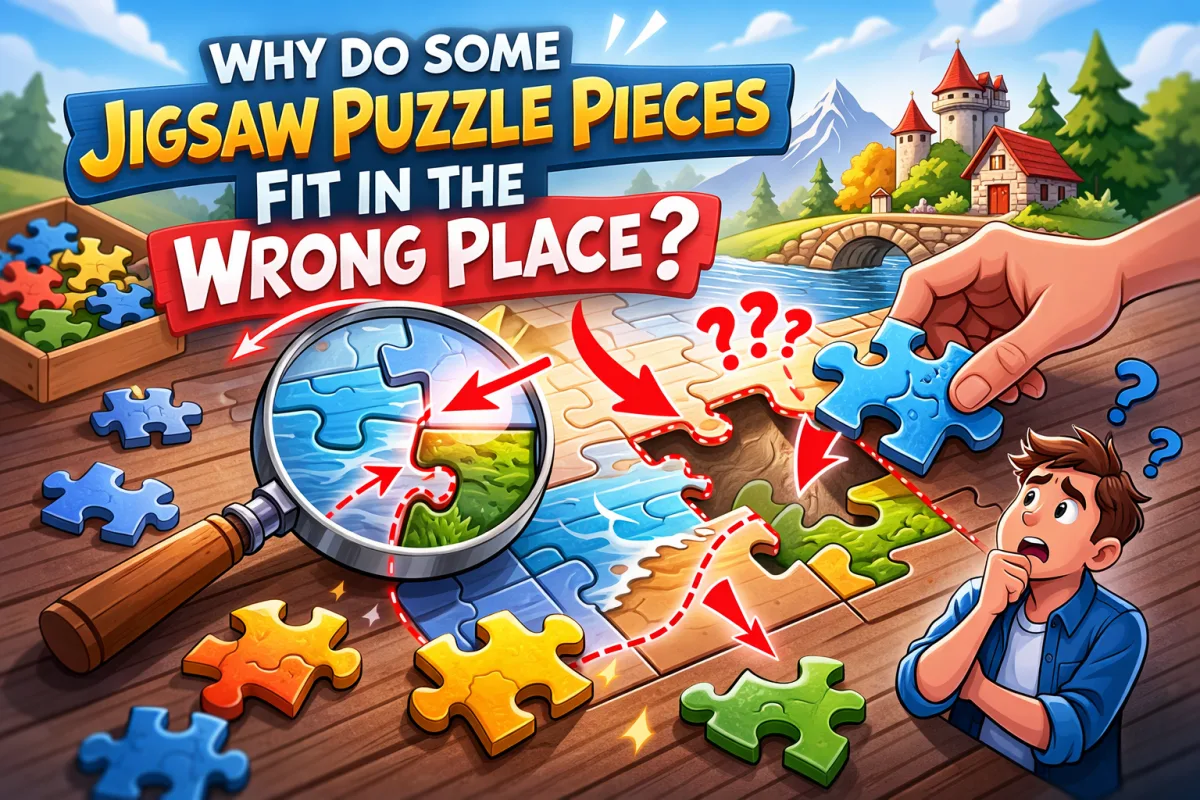
If you’ve ever completed most of a jigsaw puzzle only to discover that one section “doesn’t close,” you’ve likely experienced a classic false fit. A piece seemed correct, locked into place, and visually looked acceptable — but later turned out to be wrong.
In puzzle terminology, a false fit is a situation where a piece achieves mechanical locking due to similar tab and blank structure, yet fails true visual seam alignment. It is not random. It is a predictable result of geometry, manufacturing tolerance, and image ambiguity.
Understanding false fits as a defined concept — not just a frustrating mistake — helps you prevent error propagation during assembly and solve puzzles more efficiently.
“A real fit satisfies both geometry and image continuity. If one is weak, doubt it.”
What Is a False Fit in Jigsaw Puzzles?
A jigsaw connection works on two independent systems:
- Geometric interlocking mechanism — the tab and blank shapes interlock physically.
- Visual pattern continuity — printed artwork aligns seamlessly across the seam.
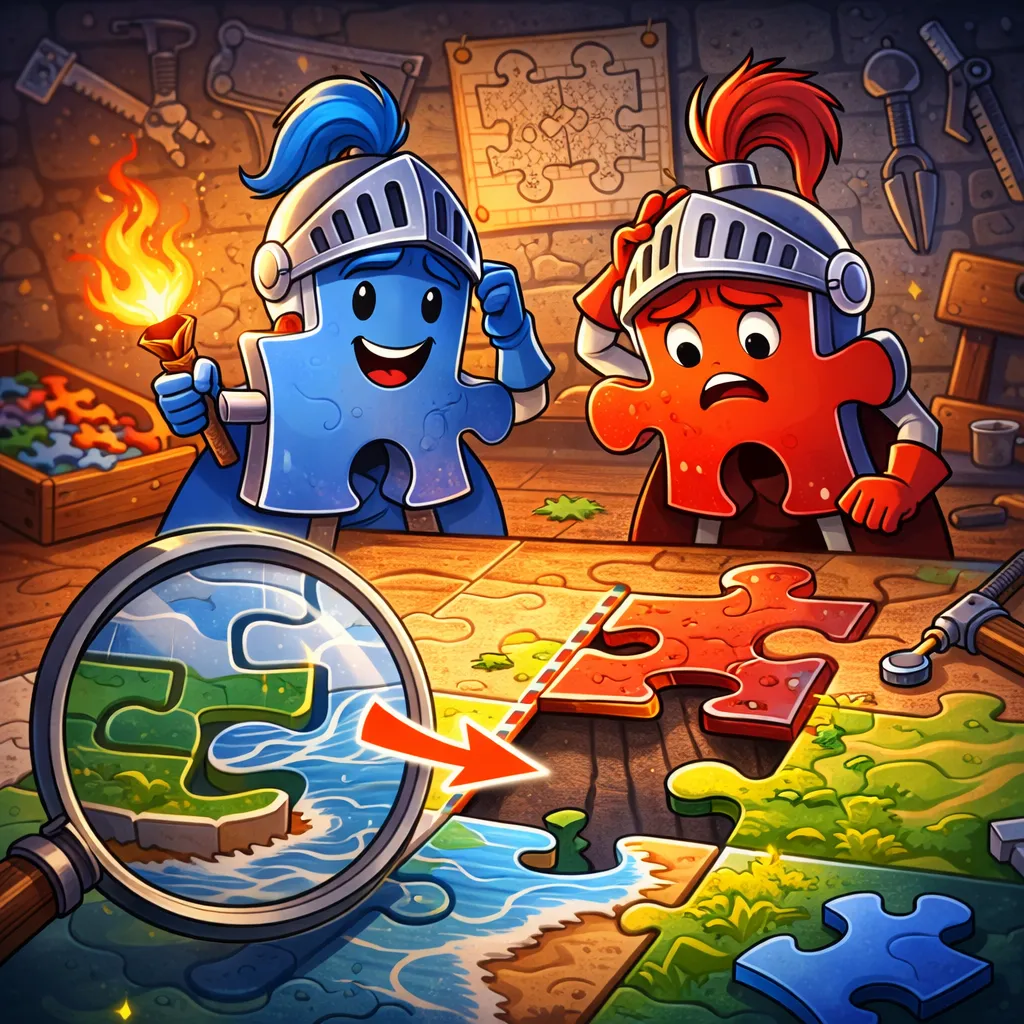
A false fit happens when geometric matching is close enough to pass, but pattern continuity is incorrect. The curvature radius, neck width, or shoulder shape may be similar enough to allow insertion, even though the piece profile variation was intended for another location.
Two Types of False Fits
Soft False Fit
The piece goes in but feels slightly loose. Minor seam misalignment or micro-gaps are visible under close inspection. These are easier to detect.
Hard False Fit
The piece locks tightly due to cutting tolerance overlap. These are dangerous because they survive multiple solving steps before being detected.
Why Do Puzzle Pieces Fit but Are Wrong?
1. Similar Piece Geometry and Cut Pattern Repetition
Most cardboard puzzles are die-cut using repeating cut templates. When piece symmetry and curvature radius are reused across the board, multiple pieces may share similar geometric constraints.
High symmetry tabs and shallow curves increase the probability of geometric mismatch going unnoticed. Short neck lengths and uniform tab families reduce mechanical uniqueness.
2. Manufacturing Tolerance and Die Wear
No die-cut cardboard puzzle is mathematically perfect. Manufacturing tolerance allows tiny deviations in:
- Neck width
- Shoulder angle
- Edge crispness
- Board thickness variation
Over time, die wear softens cutting precision. Cardboard compression and puzzle dust accumulation also affect how tightly pieces seat. In humid environments, cardboard may expand slightly, increasing the likelihood of temporary false fits.
| Manufacturing Factor | Technical Effect | Impact on False Fits |
|---|---|---|
| Die wear | Rounded edges | More near-matches accepted |
| Cutting tolerance | Micro-size deviations | Hard false fits possible |
| Humidity expansion | Cardboard swelling | Temporary tight misfits |
| Board thickness variation | Uneven seating depth | Flush-looking incorrect placement |
3. Image Ambiguity and Low-Contrast Regions
False fits are significantly more common in areas with low visual information:
- Sky gradients
- Water reflections
- Fog, sand, snow
- Repeating textures like brick or leaves
When gradient transitions are subtle and pattern recognition cues are weak, the brain accepts approximate matches. This is a classic example of confirmation bias in puzzle solving.
4. Human Pattern Recognition Bias
The brain seeks closure. When a piece appears plausible, solvers often commit prematurely — a behavior known as premature locking. Without adding a second geometric constraint, a wrong placement can remain unnoticed and cause structural tension later.
“One connection is a guess. Two connections are verification.”
How to Detect a False Fit Early
Check Seam Alignment Carefully
Instead of looking at the color only, inspect the seam alignment:
- Do lines bend slightly?
- Does texture abruptly shift direction?
- Is there micro-gap asymmetry?
Apply the Controlled Wiggle Test
Hold surrounding pieces steady and gently test movement.
- True fit: stable mechanical locking with minimal pivot.
- False fit: subtle rocking or uneven resistance.
Use Constraint-Based Solving
Increase certainty by requiring multiple neighboring confirmations before merging sections permanently. Constraint-based solving reduces cumulative placement error.
Why Higher Piece Counts Can Increase False Fit Risk
Larger puzzles introduce more piece profile variation, but they also increase opportunities for near-matching curvature patterns. In repeated textures, even small geometric similarities can produce convincing mechanical interlocks.
Paradoxically, some lower-quality puzzles with minimal shape variation produce more false fits than premium puzzles with highly distinctive cuts.
Digital Puzzles and Snap Logic
In digital environments, false fits depend on snap logic. Some platforms allow free placement with visual-only confirmation. Others restrict snapping strictly to correct geometric mapping.
For example, platforms like PuzzleFree.Game can configure snap behavior differently depending on difficulty settings. In stricter modes, geometric mismatch is impossible, eliminating false fits entirely. In freer modes, user judgment plays a larger role.
Common Scenarios Where False Fits Occur
- Large sky or water sections
- Repeated architectural patterns
- Floral or foliage textures
- Abstract or AI-generated gradients
- Old puzzles with softened edges
Quick Diagnostic Table
| Symptom | Likely Cause | Technical Explanation |
|---|---|---|
| Section refuses to close | Earlier hard false fit | Accumulated geometric mismatch |
| Piece looks right but line breaks | Image ambiguity | Low-contrast pattern region |
| Piece fits many locations | High symmetry cut pattern | Insufficient shape uniqueness |
| Tight but slightly raised edge | Board thickness deviation | Uneven seating tolerance |
Final Insight
False fits are not accidents. They are the intersection of geometric similarity, manufacturing tolerance, and human pattern recognition bias. Once you understand this entity clearly, puzzle solving becomes less about guessing and more about verification.
Every placement should satisfy two independent constraints: mechanical locking and visual continuity. If one is weak, reconsider. That single habit eliminates most long-term assembly errors.