PuzzleFree
Why Jigsaw Puzzles Have Different Names Worldwide
February 10, 2026
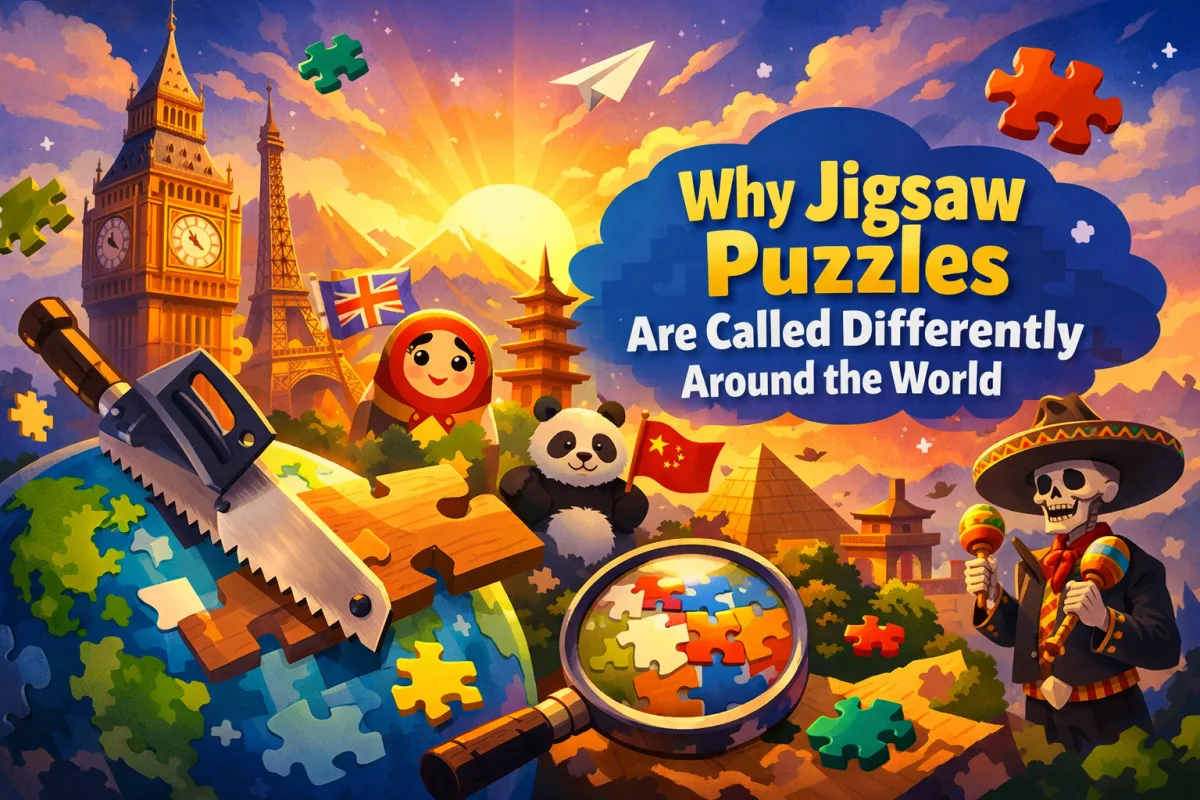
Jigsaw puzzles look the same everywhere: small interlocking pieces that form a complete picture. However, the words people use for these puzzles vary widely from country to country. In English they are called jigsaw puzzles, in Russian — пазлы, in Spanish — rompecabezas, and in Chinese — 拼图, meaning “assembled picture”.
These differences are not random. They reflect history, language structure, translation choices, and how the object was first introduced in each culture. This article explains why jigsaw puzzles have different names around the world and what those names reveal about language and perception.
What Are Jigsaw Puzzles?
A jigsaw puzzle is a picture-based puzzle made of many uniquely shaped pieces that interlock to form a complete image. Unlike word puzzles or riddles, jigsaw puzzles rely primarily on visual recognition, shape matching, and spatial arrangement.
Although the format is universal, the terminology used to describe these puzzles differs significantly between languages.
Where the Name “Jigsaw Puzzle” Comes From
The term jigsaw puzzle originated in 18th-century England. Early versions were educational tools known as “dissected maps”, where wooden boards with printed maps were cut into pieces for students to reassemble.
As cutting techniques improved, craftsmen began using a fine saw called a jigsaw. Over time, the name of the tool became associated with the puzzle itself.
Importantly, the English name describes how the puzzle was made, not what the user does when assembling it. This historical detail did not transfer to other languages.
Why Other Countries Don’t Use the Word “Jigsaw”
When jigsaw puzzles spread internationally, most countries did not translate the English term directly. Instead, languages adopted names based on meaning, function, or experience.
Three main naming patterns emerged worldwide:
- Borrowing the word “puzzle”
- Describing mental challenge
- Describing the act of assembling a picture
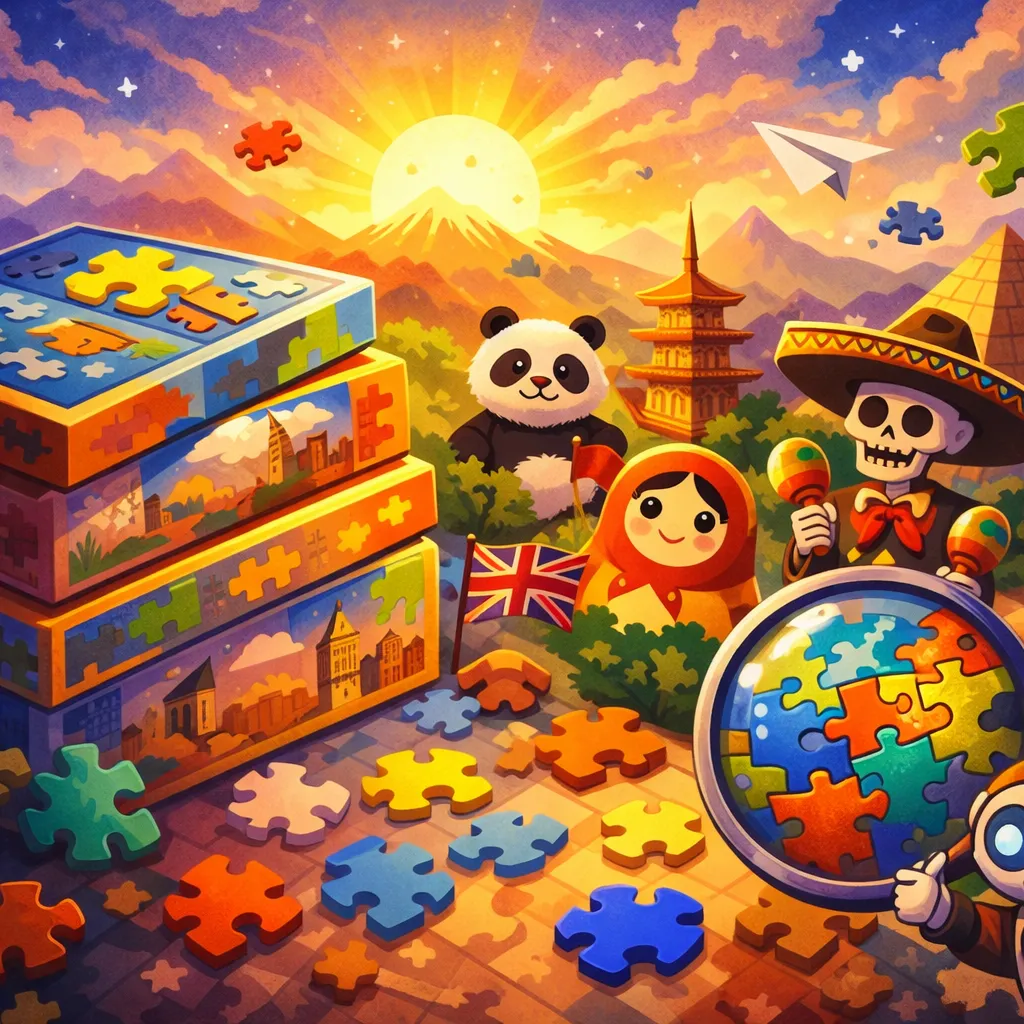
How Jigsaw Puzzles Are Named in Different Languages
Although the object itself is the same, languages describe jigsaw puzzles in very different ways. Some borrow the English word “puzzle”, others describe mental challenge, while some focus on assembling a picture.
| Language | Country / Region | Local Term | Literal Meaning or Origin |
|---|---|---|---|
| English | USA, UK | Jigsaw puzzle | Named after the jigsaw cutting tool |
| Russian | Russia | Пазл | Borrowed from English “puzzle” |
| German | Germany, Austria | Puzzle | Direct borrowing from English |
| French | France | Puzzle | Borrowed international term |
| Spanish | Spain, Latin America | Rompecabezas | “Head-breaker” (mental challenge) |
| Portuguese | Brazil | Quebra-cabeça | “Head-breaker” |
| Chinese | China | 拼图 | “Assembled picture” |
| Japanese | Japan | ジグソーパズル | Phonetic form of “jigsaw puzzle” |
| Korean | South Korea | 직소 퍼즐 | Phonetic borrowing from English |
| Vietnamese | Vietnam | Xếp hình | “Arranging shapes” |
| Finnish | Finland | Palapeli | “Piece game” |
| Hungarian | Hungary | Kirakós | “Something that is laid out” |
| Thai | Thailand | จิ๊กซอว์ | Transliteration of “jigsaw” |
Languages That Borrowed the Word “Puzzle”
Many languages adopted the English word puzzle with minimal changes. Examples include German, French, Italian, Polish, Japanese, Arabic, and Hebrew.
In these languages, the borrowed term often refers specifically to jigsaw puzzles, even though in English the word “puzzle” has a broader meaning. This led to a narrowing of meaning over time.
Languages That Describe “Breaking the Head”
Some languages focus on the mental effort involved rather than the visual process. Spanish uses rompecabezas, and Portuguese uses quebra-cabeça, both translating roughly to “head-breaker”.
These terms existed before modern jigsaw puzzles and were applied broadly to many types of challenges and riddles.
Languages That Describe “Assembling a Picture”
Several languages describe jigsaw puzzles by emphasizing the act of assembling an image. Chinese uses 拼图, meaning “assembled picture”, while Vietnamese uses xếp hình, meaning “arranging shapes”.
This approach focuses on the visual and physical nature of jigsaw puzzles, rather than tools or mental difficulty.
Why Russian Uses the Word “Пазл”
In Russian, the word пазл is a direct borrowing from English. Before the 1990s, similar games were commonly described as мозаика or разрезная картинка.
When Western puzzle products entered the market, the English word “PUZZLE” appeared on packaging and was adopted directly. Over time, пазл came to mean only jigsaw puzzles, while головоломка remained the general term for puzzles.
How the Meaning of “Puzzle” Changed Across Countries
In English, “puzzle” refers to many different types of problems and games. In many other languages, the borrowed equivalent refers only to jigsaw puzzles.
This difference affects search intent, expectations, and how people understand what kind of activity is being offered.
Why This Matters for Puzzle Websites and Apps
Understanding local terminology helps puzzle websites and apps match user expectations more accurately. People searching for puzzle content in different languages often expect very specific formats based on the words they use.
Using the correct local term improves clarity, relevance, and user experience, especially for international audiences.
Frequently Asked Questions
Why are jigsaw puzzles called puzzles?
Because the English word “puzzle” historically referred to anything that required solving.
Why doesn’t every language use the word “jigsaw”?
Because the term comes from a specific English tool that was not relevant elsewhere.
Why does Russian use the word “пазл”?
Because the word entered the language through imported products rather than translation.
What is the most common name for jigsaw puzzles worldwide?
Variations of the borrowed word “puzzle” are the most widespread globally.